Paid Media
Google Ads Services in India
Google Ads Services That Turn
Spend Into Qualified Growth
PPC Studio manages Google Ads as a paid acquisition system, not just a media buying account. We tighten measurement, restructure campaigns around real intent, align ads with landing pages, and improve the feedback loop that tells the platform what qualified growth actually looks like.
Why Google Ads Underperforms
Most Google Ads accounts spend more before they learn what is actually producing qualified pipeline.
The platform is powerful, but it cannot rescue a weak acquisition system. When conversion signals are noisy, search intent is blended, and the landing page breaks message continuity, budgets expand faster than lead quality.
Weak Signals
The account learns from bad conversion data, then automates in the wrong direction.
Primary conversions, calls, offline outcomes, and attribution rules often stay too loose. Once poor signals feed bidding, expensive decisions start compounding instead of correcting.
Intent Leakage
Search demand exists, but low-conviction clicks absorb the budget first.
Campaigns are often too blended, search-term control is weak, and landing pages are too generic. Traffic grows, but the account never separates curiosity from buying intent.
The Paid Search Reality
Strong Google Ads now depends on signal quality, intent capture, post-click alignment, and disciplined scale.
The account has to tell Google what matters, route budgets toward high-conviction demand, and protect efficiency as spend expands. Better performance comes from the operating system around the campaigns.
What Our Google Ads Services Cover
Four connected layers that make paid acquisition easier to trust and easier to scale.
Strong Google Ads performance is not one campaign setting. It is a connected operating system built around measurement integrity, intent capture, message continuity, and budget discipline.
Tracking, Attribution, and Measurement
We start by tightening the data layer so Google Ads optimises toward meaningful outcomes. That includes primary conversions, call and form tracking, offline conversion support where possible, attribution hygiene, consent-aware tagging, and CRM-ready handoff.
Campaign Architecture and Intent Capture
We structure campaigns around how buyers search and how valuable each search actually is. That can include Search, Shopping, Performance Max, remarketing, branded search, non-brand acquisition, and search-term controls that keep low-conviction traffic from distorting the account.
Creative, Offer, and Landing Page Alignment
Clicks turn into pipeline when the message stays consistent from search query to ad to offer to landing page. We tighten the promise so users land on something that matches what they searched for and know what to do next.
Optimization, Budget Control, and Scaling
We only scale what has already proved it can protect lead quality and acquisition cost. That means budget reallocation, bid and query refinement, efficiency thresholds, pacing controls, and weekly decisions tied back to real commercial outcomes.
Scale control surface
Budgets should move toward the campaigns, search terms, and landing-page paths that keep producing qualified conversions after the account is cleaned up.
How We Work
A practical Google Ads roadmap built for the first 90 days and beyond.
The first job is to find signal loss fast. From there, we clean the measurement layer, tighten intent capture, rebuild weak campaign paths, and only scale what can protect acquisition efficiency.
Execution rhythm
Phase 01
Audit and Signal Check
We review campaign architecture, search terms, conversion actions, bids, budgets, landing pages, and lead quality feedback to find where acquisition cost is being distorted.
Output
Account audit, wasted-spend map, and measurement repair listPhase 02
Tracking and Search-Term Cleanup
We tighten the conversion layer, clean up noisy signals, improve call or form tracking, review attribution, and push query control so low-conviction demand stops confusing the account.
Output
Cleaner measurement and tighter query controlPhase 03
Campaign Rebuild and Offer Alignment
We restructure campaigns around stronger intent groupings, refresh ad messaging, align the offer and CTA, and improve the post-click experience so the account has a better path from search to conversion.
Output
Stronger account structure and higher-conviction traffic pathsPhase 04
Optimisation, Budget Reallocation, and Scale
We review cost per lead, conversion rate, ROAS where available, lead quality, and search-term quality every week so budgets move toward the acquisition paths that are proving themselves.
Output
Measured optimisation rhythm and a proven scale pathProof of Execution
Paid media results improve when the account learns from cleaner signals and stronger intent control.
These outcomes span D2C, B2B, retail, and global accounts. The shared pattern is better measurement, tighter campaign logic, and more disciplined scaling after the weak paths are removed.
Result mix
4,348%
Peak ROAS achieved in one account context
₹1.77Cr+
Revenue generated across active partnerships
3,280+
Qualified acquisitions in a 30-day cycle
Evidence inspector
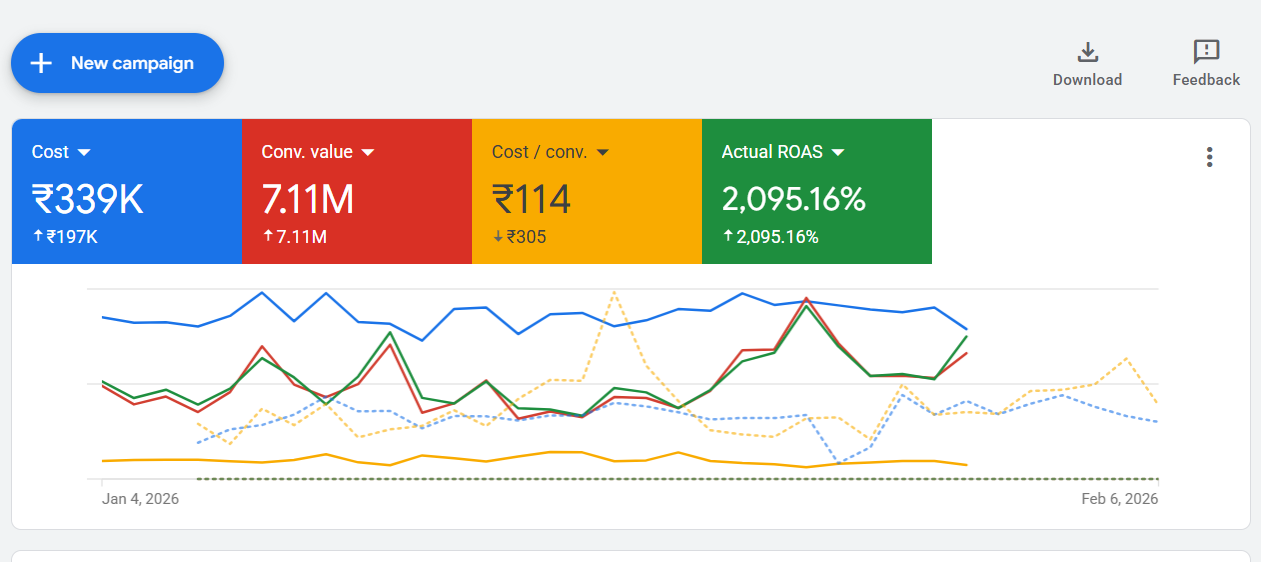
CAC reduced from ₹340 to ₹114
A D2C account improved efficiency by tightening campaign structure, improving conversion signals, and focusing spend on stronger purchase intent.
Paid Signal Observatory
Google Ads gets easier to scale when signal quality, intent capture, and conversion feedback stay connected.
Paid search works best when the account knows what a valuable conversion is, separates high-conviction demand from weak traffic, and sends the learning back into weekly budget decisions. Break one layer and the whole system gets noisier.
At a glance
Choose a paid acquisition layer
Each tab shows what that layer is controlling, what breaks when it is weak, and what the account should learn from it.
Signal Quality
The account should know the difference between a low-value action and a real buying signal.
If the wrong conversions feed bidding, automation multiplies the error. Strong accounts define primary actions, separate secondary events, and build the data path back to sales or revenue wherever possible.
- Primary goal
- Tell Google Ads which outcomes are valuable enough to optimise toward.
- What gets tightened
- Primary conversions, calls, forms, offline imports, attribution logic, and duplicate-signal cleanup.
- Typical account clue
- Leads look busy in-platform, but sales teams do not trust the quality or close rate.
- Business effect
- Bids and budgets start moving toward qualified outcomes instead of weak proxies.
Measurement view
Optimisation path
Primary conversion, call tracking, and offline feedback work as one signal set.
The platform learns faster when the high-value outcome is clear and the weak events stay out of bidding.
What gets checked
- Primary versus secondary actions
- Call and form integrity
- Offline lead or revenue imports
Intent Capture
Campaigns should separate curiosity from buying intent before budget gets allocated.
When branded, non-brand, competitor, Shopping, PMax, and remarketing traffic are blended too loosely, the account cannot tell where conviction lives. Campaign structure should make that difference obvious.
- Primary goal
- Capture the demand most likely to become qualified pipeline or profitable revenue.
- What gets structured
- Campaign separation, search-term themes, keyword coverage, negatives, audience overlays, and remarketing logic.
- Typical account clue
- Spend rises quickly, but search terms and landing pages do not reflect consistent buying intent.
- Business effect
- Budgets shift toward better-fit traffic instead of subsidising generic clicks.
Intent map
Intent split
Brand, high-intent non-brand, competitor, and remarketing sit in distinct lanes.
The account can see which lane deserves more budget and which one needs tighter controls.
Control points
- Search-term quality
- Negative keyword themes
- Offer-to-query relevance
Conversion Feedback
Scale decisions should follow what happens after the click, not just what happened in the dashboard.
A good account closes the loop between ad spend, landing-page performance, lead quality, sales feedback, and margin reality. That is what makes budget reallocation more disciplined over time.
- Primary goal
- Find the acquisition paths that can take more budget without degrading efficiency.
- What gets reviewed
- CPL, CAC, ROAS, conversion rate, lead quality, search-term quality, and landing-page drop-off.
- Typical account clue
- Campaigns look scalable in-platform, but quality drops as soon as spend increases.
- Business effect
- Budget moves toward the combinations of intent, offer, and post-click experience that keep performing.
Feedback loop
Decision loop
Conversion quality, search-term quality, and landing-page clarity decide what earns more budget.
Scale follows evidence, not platform activity. The account grows only after the good paths prove they can hold efficiency.
Weekly outputs
- Budget reallocation
- Bid and query adjustments
- Landing-page and offer fixes
Why PPC Studio
A Google Ads partner focused on signal integrity, intent discipline, and scale that the business can actually support.
Many Google Ads accounts are managed like platform checklists. We manage them like acquisition systems that need clean inputs, clear commercial priorities, and a feedback loop the business can trust.
That means we care about what happens before the click and after it. The keyword, ad, offer, landing page, sales process, and measurement model all shape whether paid search becomes efficient or expensive.
Signal-first optimisation
We optimise toward meaningful conversions and revenue signals, not shallow events that make the dashboard look healthier than the business feels.
Intent-led campaign structure
Campaigns are separated by conviction and search behavior so budgets flow toward better demand instead of being diluted across mixed traffic.
Post-click accountability
We do not pretend the ad account exists in isolation. Offer clarity, landing-page fit, and lead follow-through all shape whether paid traffic becomes profitable.
Business-facing scale decisions
Reporting ties back to CPL, CAC, ROAS, lead quality, and scale readiness so budget increases are easier for the business to approve and sustain.
Verified Client Reviews
Independent Proof, Presented Better
Live Clutch reviews now sit directly inside the page, and Google proof is presented as a premium on-page trust snapshot for faster decision-making.
Kiran
7 weeks ago
1 review • 0 photos
★★★★★
We had a very positive experience with PPC Studio. Mr. Subodh was personally involved and reviewed even the smallest details with care.
Leena Guha Roy
27 weeks ago
Local Guide • 11 reviews • 3 photos
★★★★★
Our B2B lead-gen campaigns with PPC Studio have been seamless, creative, and result-oriented.
Gaurav Tandon
32 weeks ago
8 reviews • 7 photos
★★★★★
A young and dynamic group that listens, understands, and delivers at top industry standards.
Meena Khanna
34 weeks ago
1 review • 0 photos
★★★★★
PPC Studio has consistently delivered on commitments and improved our online presence with strong lead quality.
Public Google Review Snapshot
Google Review
★★★★★
ACCREDITATIONS & RECOGNITION
Validated by independent industry platforms.
Google Ads Strategy Session
Find where your Google Ads budget is leaking and what to fix first.
We review account structure, conversion tracking, search terms, landing page alignment, and lead quality so you can see which changes are most likely to improve efficiency over the next 90 days.
Best fit for brands that want measurable paid acquisition improvements, not just more activity in the ad account.
Frequently Asked Questions
Common questions about our Google Ads services
What do your Google Ads services include?+
Our Google Ads services cover account audits, conversion tracking, campaign strategy, Search, Shopping, Performance Max, remarketing, display or YouTube support where relevant, landing page input, budget planning, bidding strategy, search query management, creative testing, and ongoing performance reporting.
How long does Google Ads take to start working?+
Google Ads can begin generating traffic and leads soon after launch, but reliable optimisation usually takes several weeks of clean conversion data. Most accounts need 30 to 90 days to stabilise tracking, refine targeting, improve landing pages, and identify the campaigns that can scale efficiently.
How do you measure Google Ads ROI?+
We measure Google Ads using the business metrics that matter most to the account: qualified leads, sales, cost per lead, cost per acquisition, conversion rate, revenue, return on ad spend where ecommerce tracking is available, and pipeline quality where offline sales data can be connected.
Do you help with conversion tracking and offline attribution?+
Yes. Good optimisation depends on trustworthy data. We help structure tracking for form fills, calls, purchases, qualified leads, and where possible offline conversion signals so bidding decisions reflect real outcomes instead of weak proxies.
Which Google Ads campaign types do you manage?+
We manage Search campaigns, Shopping, Performance Max, remarketing, brand and non-brand campaigns, competitor campaigns where appropriate, and YouTube or Display when they support the acquisition strategy rather than distract from it.
Who is Google Ads a good fit for?+
Google Ads is often a strong fit for businesses with clear demand, defined conversion actions, healthy margins, and the operational ability to respond to leads or fulfill sales quickly. It can work for B2B, ecommerce, local services, healthcare, and multi-location brands when the account structure matches the buying journey.